There’s a version of wholesale buying where you take one of everything, put it all in the case, and let the customers tell you what works. It’s a reasonable way to start. It’s also a slow, expensive way to learn something you could have known in advance.
Depth buying is the opposite decision. When you commit to ten pieces of a single reference, you’ve stopped hedging. You’re saying: this exact watch, this exact dial, this exact size, will move through my store often enough that having ten of them is better than having one each of ten.
Get that right and your cost per piece drops, your case looks intentional instead of scattered, and you stop reordering singles at full price. Get it wrong and you’re sitting on nine watches in a colour nobody in your town wants.
This is about the quartz Tissot PRX line specifically — where the depth bet is unusually safe, and where it isn’t.
Why PRX Is the Line to Go Deep On
Most references don’t deserve a ten-piece commitment. The PRX is a rare case where it makes sense, for three reasons that have nothing to do with the watch itself.
Demand is already built. Your customer walks in knowing what a PRX is. They’ve seen it on Instagram, in a “best watch under $500” list, on a colleague’s wrist. You are not educating anyone. You’re stocking something that has already been sold to them by other people, for free.
The hype curve has flattened. The PRX peaked around 2023–2024. That sounds like bad news and isn’t. Post-hype means no flippers, no allocation nonsense, no customers who buy to resell. What’s left is steady, boring, predictable demand — which is exactly the condition under which depth buying works. You cannot safely go ten deep on something whose demand curve is still moving.
Cost is flat across the line. Every quartz PRX costs the same at wholesale regardless of size or dial. That’s unusual and it’s useful, because it means your reference choice is a pure sell-through decision. You’re not trading margin against popularity. Pick the one that sells fastest; it costs the same as the one that sells slowest.
So the question isn’t whether to go deep on PRX. It’s which one.
35mm or 40mm: Not the Split You Expect
Most dealers instinctively treat 40mm as the safe men’s default and 35mm as the women’s variant. That framing costs money.
The 35mm PRX is not a women’s watch. It’s a unisex watch that happens to work for women, and in 2026 it’s being bought by a meaningful number of men who’ve moved on from oversized cases. If you’re stocking 35mm exclusively for the women’s counter, you’re showing it to half the people who’d buy it.
Here’s the practical difference:
| 35mm | 40mm | |
|---|---|---|
| Primary buyer | Women, small-wristed men, gift buyers | Men, everyday-wear buyers |
| Gift purchase rate | High — anniversaries, graduations | Moderate |
| Return rate | Lower (fit is forgiving) | Higher (case-size regret) |
| Sells without trying on | Yes | Less often |
| Depth risk | Lower | Slightly higher |
That last row is the one that matters for a ten-piece buy. The 35mm has a wider tolerance for wrist size, which means fewer “it looked good online” returns and more confident gift purchases. If you’re nervous about committing, 35mm is the more forgiving bet — the opposite of most dealers’ instinct.
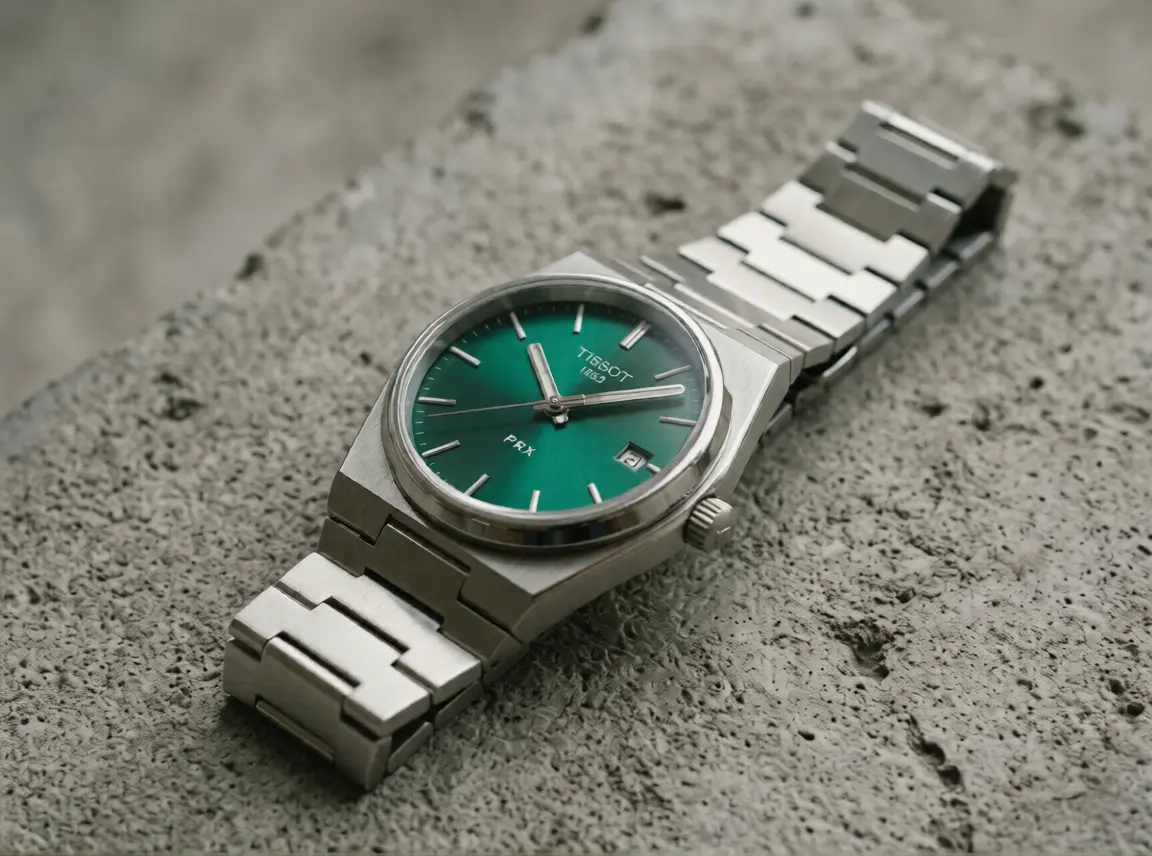
The 40mm still outsells it in most stores. But “outsells” and “safer to stock ten of” are different questions, and depth buying is a question about variance, not averages.
Dial by Dial
This is where the depth decision actually gets made. Same case, same movement, same cost — completely different sell-through.
Silver — the one you can’t get wrong
The 35mm silver dial and the 40mm silver dial are the closest thing to a default PRX. Silver reads as dressy under store lighting and as casual on the wrist. It matches everything the customer already owns. It photographs well, which matters more than dealers admit when the customer is standing there taking a photo to send to their partner before buying.
If you have never gone deep on a PRX and you want to find out whether depth buying works in your store, do it with silver. It is the reference least likely to teach you an expensive lesson.
Blue — the best all-rounder
The 35mm blue sun-brushed and the 40mm blue are the enthusiast’s pick and, unusually, also the general public’s pick. Blue dials have been the safest non-neutral colour in the entire watch industry for a decade and PRX blue is one of the better executions at any price.
Sun-brushed finishing is doing real work here. Under the case lights it shifts from near-black to bright blue as the customer tilts it. That’s a thirty-second demo that closes sales, and it’s the reason blue outperforms its share of shelf space almost everywhere.
Blue is the reference to go deep on if you want maximum sell-through rather than maximum safety.
Light blue — seasonal, and know your season
The 35mm light blue is a different animal from the standard blue. It’s brighter, softer, and distinctly spring/summer. In a coastal or warm-climate store it can outsell everything. In a market with a real winter, it goes quiet for four months a year.
Ten deep on light blue is fine if you’re buying in March. It’s a mistake in September.
Green — the one that splits rooms
The 35mm green and 40mm green are the references dealers most often get wrong in both directions.
Green PRX has genuine fans. It also has customers who look at it, say “hm,” and pick up the silver. There’s very little middle ground — people either want the green specifically or they don’t want it at all. That bimodal response is exactly what you don’t want in a depth buy. Two or three pieces, absolutely. Ten is a bet on your local market having more green people than average, and most markets don’t.
If you already know green moves for you, ignore this. If you’re guessing, guess something else.
Black — the 40mm sleeper
The 40mm black dial gets overlooked because black dials are boring to look at in a catalogue. In a store they sell steadily to the customer who wants one watch that works with a suit and with jeans, and who doesn’t want to think about it again.
Black is a quiet, unglamorous, dependable depth pick. It won’t be your fastest seller. It also won’t sit.
Champagne gold PVD — a different customer entirely
The 35mm and 40mm gold PVD references are not variants of the steel PRX. They’re a separate product serving a separate buyer, and treating them as “the gold one” is why they underperform in stores that stock them carelessly.
The customer for gold PVD is buying jewellery that tells time. They care about how it looks against their other gold pieces. They are frequently the same customer who buys two-tone dress watches, and they are almost never the customer who came in asking about the PRX by name.
Two implications. First, gold PVD needs to be merchandised near your dressier stock, not lined up with the steel PRX where it reads as the odd one out. Second, PVD coating is a wear surface — it will show edge wear over years in a way steel won’t, and you should know that before a customer asks rather than after.
Go deep on gold PVD only if you already sell gold-tone watches well. It’s the least transferable reference in the line.
The Quartz Objection, and How to Kill It
You’ll get this from one customer in ten, usually a man who’s read enough to be dangerous: “It’s only quartz?”
Don’t get defensive, and don’t oversell. The honest answer wins:
Quartz is the right movement for this watch. It’s accurate to a few seconds a month where an automatic drifts that much in a day. It runs for years without being worn. It’s thinner, which is why the PRX sits under a shirt cuff properly. And your customer isn’t winding a watch every morning — they’re picking one off a tray and leaving.
There’s also a small feature worth mentioning, because it converts an objection into a selling point: these movements have an end-of-life battery indicator. When the battery gets low, the second hand starts moving in four-second jumps instead of ticking once a second. The customer gets weeks of warning instead of finding a dead watch on the morning of an event. Say that out loud in the store. It reframes quartz from “cheaper option” to “engineered so you don’t get caught out.”
The customer who genuinely wants a mechanical Swiss watch is a real customer — send them to the Le Locle Powermatic 80 instead of talking them into a PRX. That’s a different sale, and we’ve covered how those two lines split elsewhere.
The Three Safest Depth Picks
If you’re committing to a single reference and you want the shortest path to being right:
- 40mm silver — the broadest possible buyer. Nothing about it narrows your market. If ten pieces of this don’t move, the problem isn’t the reference.
- 40mm blue — the highest ceiling. Sells to the enthusiast and the walk-in equally, and the sun-brushed demo does real work at the counter.
- 35mm silver — the gift engine. Covers a category most dealers under-serve, and the forgiving fit keeps returns down.
Two of those three are silver, which is not an accident. Depth buying is a variance decision. The colour that offends nobody is the colour you can afford to have ten of.
What not to do: don’t put your whole depth buy into a single strong colour because it’s the one you personally like. The dealer’s taste and the market’s taste correlate less than any of us want to believe. If you want green in your case, buy green shallow and buy silver deep.
When Depth Buying Actually Pays
The maths only works if your turn rate justifies it. Rough rule: if a reference sells at least one piece a month in your store, ten pieces is under a year of stock and the depth discount is worth having. If it sells one every two months, you’ve tied up cash for two years to save a few dollars a piece. That’s not a deal, that’s a warehouse.
Be honest about which of those you are before committing. A depth buy on a reference you sell twice a year is the most expensive way to feel like you got a bargain.
Every quartz PRX reference discussed here is in the PRX line-up at a flat dealer price — same per-piece cost whether you take one or ten, so a depth buy is a call about your turn rate, not about hitting a tier. Pricing is dealer-only; if you’re not registered yet it takes about a minute.
Questions about which reference suits your market specifically — send us your city and what you currently sell through fastest. That’s a more useful conversation than a price list.