“JDM Seiko” is one of those phrases that gets thrown around in watch forums like everyone already knows what it means. Most retailers — especially ones new to the brand — don’t. And the dealers who don’t understand the JDM distinction are the same ones leaving money on the table by stocking only the international versions of Seiko’s catalog.
So let’s settle it. JDM stands for Japan Domestic Market. A JDM Seiko is a reference originally built and intended for sale inside Japan. It’s not a different brand, it’s not a knockoff, and it’s not illegal to sell outside Japan. It’s the same Seiko factory, the same quality control, often the same watch at a glance — but with spec upgrades that the international versions don’t get.
This article is the explainer your sales floor probably needs. What JDM actually means, how to identify one, what’s different, and whether you should care as a retailer.
How to Tell a JDM Seiko from an International One
The reference code does most of the work. Once you know what to look for, you can identify a JDM Seiko in two seconds.
The Suffix Tell
Most modern Seiko references end with a letter and a number — for example, the SPB143J1 versus the SPB143K1.
- J suffix = Japan Domestic Market (JDM)
- K suffix = International (rest of world)
Same base model number (SPB143), different last letter. The “J” version was built for Japanese retail; the “K” version was built for international distribution. Same case, same dial design, often the same MSRP in their respective markets — but the J usually carries spec upgrades the K doesn’t.
This pattern holds across most of the Prospex catalog and a chunk of the 5 Sports line. The SSK017 — yes, the yellow-dial GMT we’ve written about extensively — is sometimes listed with a J variant in the Japanese market with subtle differences.
The Prefix Tell
There’s a second tier of JDM Seikos that don’t bother with a suffix at all — they have entirely Japan-only model codes.
- SBE, SBP, SBDC, SBDX, SBGA, SBGM = exclusively JDM
- SARB, SARG, SARX = older JDM lines (no longer in production but still in collector circulation)
The SBEJ021 — a 1968 Heritage GMT we carry at $403 wholesale — is a pure JDM piece. There is no international K-suffix equivalent. If you want this watch, you’re getting the Japanese-market spec or you’re not getting it.
The high-end Grand Seiko codes (SBGA, SBGM, SBGW) are technically a separate brand now, but the naming convention comes from the same JDM lineage.
What’s Actually Different on a JDM Seiko
Here’s where the spec sheet starts to matter. Side-by-side, the J and K versions of the same model often look identical from a meter away. The differences live in the build.
Crystal
International (K) models usually ship with Hardlex — Seiko’s proprietary mineral crystal. It’s tougher than standard mineral glass, scratch-resistant in normal use, and cheap to produce.
JDM (J) models in the Prospex tier typically ship with sapphire. Same case, same dial, same movement — different crystal. The sapphire upgrade alone is worth $80–$120 in retail value to your customer.
This is the single biggest visual differentiator. A scratch test will tell you immediately. So will the way light catches the crystal — sapphire has a slightly different optical character that watch enthusiasts notice instantly.
Movement
The international 5 Sports line runs on the 4R36 caliber — 41-hour power reserve, hacking and hand-winding, the workhorse Seiko has built thousands of variants around. It’s a fine movement for the price.
JDM Prospex pieces step up to the 6R35 (70-hour power reserve), the 6R54 (automatic GMT), or the 6R55 (300m diver-rated automatic). These are objectively better calibers — longer reserve, better regulation tolerances, often anti-magnetic.
The SPB143J1 we carry runs the 6R35. The SBEJ021 runs the 6R54. The SPB481J1, SPB483J1, and SPB485J1 300m divers all run the 6R55. Every one of those is a movement tier above what the international K-suffix versions get.
Finishing
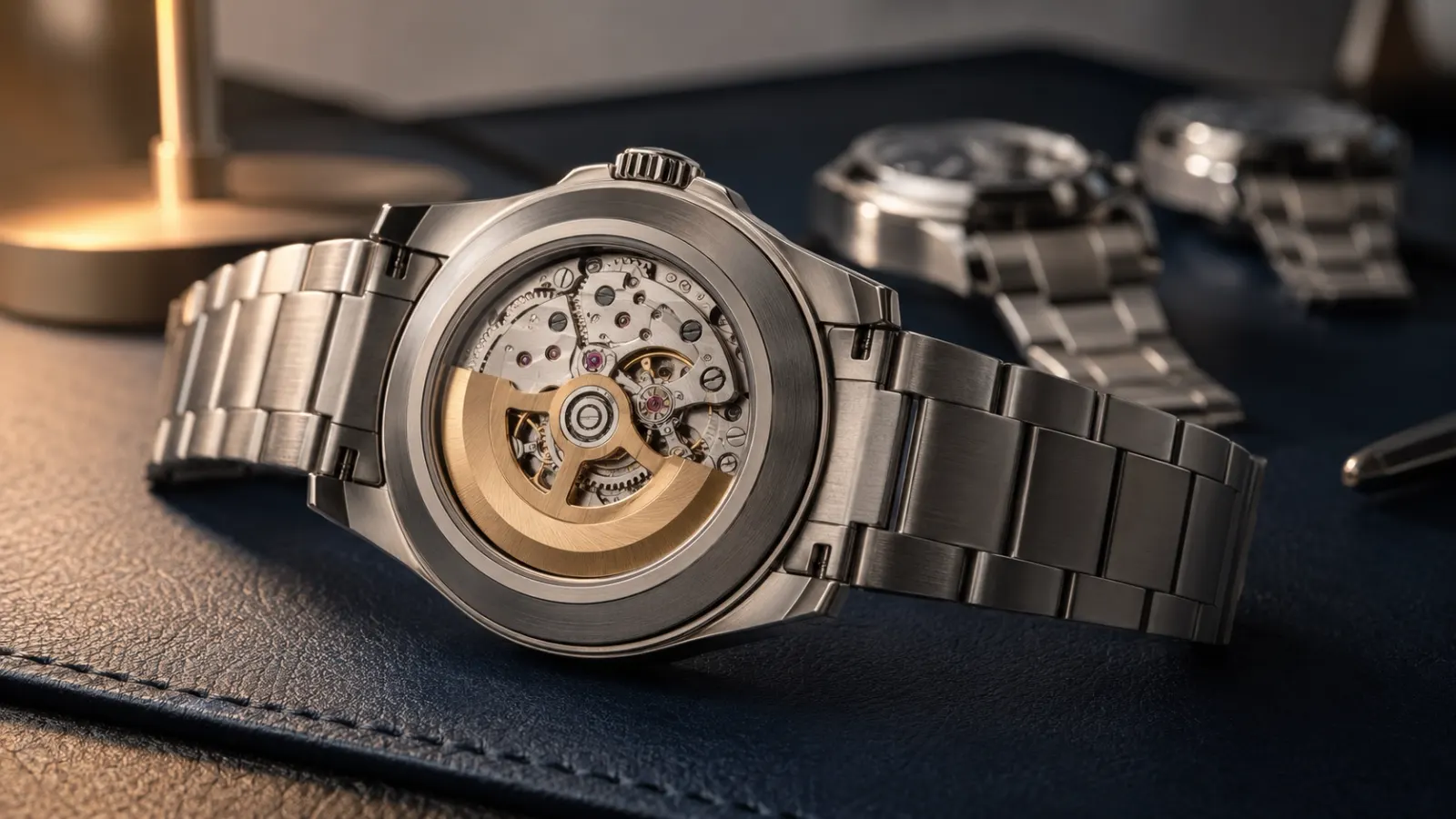
Open the caseback, hold the watch in good light, and you’ll see the third difference. JDM Prospex models get applied indices instead of printed. They get brushed-and-polished case finishing instead of single-pass machining. The dial textures are deeper. The hands have sharper bevels.
None of this matters to a casual gift buyer. It matters enormously to a customer who’s read three forum threads before walking into your store. And it justifies the $200–$400 price difference between the J and K versions at retail.
Packaging and Documentation
JDM Seikos ship with Japanese paperwork. The warranty card says “Japan domestic” in English, but the rest of the documentation may be in Japanese. Some collectors love this. Some retail customers find it confusing.
We pre-flag this on every JDM order so you know what’s in the box. If your customer base is purely English-speaking and finds Japanese paperwork off-putting, the K version is the right call. If you’re selling to enthusiasts, the Japanese box is a selling point.
The Warranty Question (Be Honest About It)
This is the single concern that derails more JDM Seiko sales than anything else, so let’s address it directly.
A JDM Seiko’s official warranty is administered through Japanese Seiko service centers. Your customer cannot walk into a U.S. authorized Seiko AD with an SPB143J1 and have it serviced under warranty. The AD will check the reference, see the J suffix, and politely decline.
This sounds worse than it actually is in practice. Here’s what really happens:
-
The 4R36, 6R35, 6R54, and 6R55 movements are among the most widely serviced calibers on the planet. Any independent watchmaker familiar with Seiko can service them. Parts are not regional — a 6R35 service kit shipped from Switzerland works on a JDM 6R35.
-
Most modern Seiko movements don’t need service for 5–7 years. Manufacturing defects show up in the first 90 days or never. We’ve sold thousands of JDM Seikos and seen warranty-eligible defects in maybe 0.3% of pieces.
-
You frame it upfront. “This is a JDM exclusive — service is through us or your local watchmaker, not the U.S. Seiko AD. Here’s why that’s actually fine.” Customers who understand this buy anyway. Customers who don’t aren’t your target market for this tier.
-
You can build a relationship with one independent watchmaker in your city who can handle Seiko service. One contact, zero ongoing problems. Most cities have several.
The warranty question is theoretical for most customers. The savings — and the better watch — are real.
Why Retailers Specifically Want JDM Seikos
The consumer-side case for JDM is “better watch for the same money.” The dealer-side case is different. It’s about margin and differentiation.
Better Per-Unit Margin
A standard international Prospex with a 4R36 movement and Hardlex crystal wholesales lower, but the realistic street price tops out around $400–$500. A JDM SPB143J1 with sapphire and 6R35 wholesales at $379 against an MSRP of $1,200–$1,300 and a realistic street price of $900–$1,100.
The wholesale-to-street markup on JDM pieces consistently runs 150%+, versus 50–80% on the entry-international references. You’re moving fewer units but clearing far more gross dollars per piece.
Differentiation from Amazon and Big-Box Retail
Every Walmart, Macy’s, and Amazon listing sells the K-suffix international Seikos. Pricing pressure on those models is brutal — you’re competing against $30-shipping-included listings that erode your margin overnight.
JDM references are not stocked at those channels. Your customer can’t open Amazon and buy a SBEJ021 at a 20% discount. The pricing holds because the distribution channel is narrower. You own the customer relationship instead of competing on price.
The Enthusiast Halo Effect
A retailer who carries JDM Seikos signals expertise. Watch enthusiasts notice. They tell other enthusiasts. The community is small and well-connected — being the dealer who stocks the SPB481J1 in pearl-white instead of just the standard SRPD lineup is the kind of reputation that builds word-of-mouth referrals.
This matters more for independent retailers than for chains. If you’re competing on watch knowledge and curation, JDM stocking is one of the cheaper ways to establish that.
JDM References Worth Knowing
Six pieces that cover the JDM Seiko story:
| Reference | Series | What Makes It JDM | Wholesale | MSRP |
|---|---|---|---|---|
| SPB143J1 | Prospex 1965 Diver | 6R35, sapphire, DiaShield case | $379 | $1,200–$1,300 |
| SBEJ021 | Prospex 1968 GMT | 6R54, ceramic bezel, JDM-only | $403 | $1,390–$1,550 |
| SPB481J1 | Prospex 300m Diver | 6R55, sapphire, polygonal case | $373 | $1,000–$1,200 |
| SPB483J1 | Prospex 300m Diver | 6R55, sapphire, blue dial | $373 | $1,000–$1,200 |
| SPB485J1 | Prospex 300m Diver | 6R55, sapphire, grey dial | $373 | $1,000–$1,200 |
These are the references that justify a JDM-focused stocking strategy. Two more sit just above — the SPB439J1 Save the Ocean and the SPB475J1 U.S. Limited Edition turquoise — but those are limited runs that come and go.
For the full stocking strategy with pricing tiers and margin breakdowns, see our Seiko JDM wholesale stock guide.
What JDM Isn’t
Three myths to clear up, because we hear them constantly:
JDM is not “fake” or “grey market” in a negative sense. It’s authentic Seiko, built in the same factories, under the same quality control. The grey market issue with luxury brands like Rolex doesn’t apply here — JDM Seiko is openly sold worldwide. The brand acknowledges its existence; they just don’t centralize service across markets.
JDM doesn’t automatically mean “better.” A JDM Seiko 5 Sports is not meaningfully different from an international Seiko 5 Sports. The JDM advantage shows up in the Prospex tier and above, where the spec upgrades (sapphire, 6R movements, finishing) actually exist. Stocking the SRPD51K1 is fine — there’s no J version that’s dramatically better. Stocking the SPB143K1 instead of the SPB143J1 is the missed opportunity.
JDM isn’t illegal to sell in the U.S. This question comes up because of how it sounds. There’s no import restriction on JDM Seikos. They’re not contraband. The only legal nuance is around the warranty representation — don’t claim U.S. Seiko AD warranty support, because that’s not what your customer is getting.
Should You Stock JDM Seiko? The Short Answer
If you sell entry-tier Seikos (SRPD, SRPK basics) and your customers are mostly first-time mechanical watch buyers, JDM is not where you start. Build that customer base first.
If you have customers asking detailed questions about movements, sapphire crystals, and what makes one diver different from another — you should already be stocking JDM. That’s the customer who pays the premium and doesn’t push back on it.
If you’re somewhere in the middle — a mixed clientele, some enthusiasts, some gift buyers — start with one JDM piece. The SPB143J1 is the obvious entry point. Charcoal dial, sapphire, 6R35, instantly recognizable to anyone who’s been on a watch forum in the last five years. Display it. Watch what happens.
The Bottom Line
JDM Seiko isn’t a marketing gimmick. It’s a real spec difference that translates to a real retail experience. Better crystals, better movements, better finishing — at wholesale prices that leave room for genuine margin instead of the 30% squeeze you get on international entry-tier models.
The retailers who understand this build a Seiko business that actually makes money. The ones who don’t keep stocking the same SRPD variants and wondering why the brand feels like a treadmill.
[Browse our full Seiko wholesale catalog 鈫抅(/seiko/)
For deeper context on Seiko stocking strategy: Top 10 Seiko 5 Sports Models for Wholesale covers the entry tier, Seiko JDM Wholesale Stock & Pricing Breakdown goes deep on the margin math across the five Seiko tiers, and the Seiko SSK017 Wholesale Review breaks down the single best-selling reference in the catalog.